Address
Room 205, Building A Poly Culture Plaza, Zhengzhou
Work Hours
Monday to Friday: 7AM - 7PM
Weekend: 10AM - 5PM

In the rapidly evolving world of cold chain logistics, building a cold storage facility is no longer just about “insulation and refrigeration.” With global energy prices fluctuating and stricter environmental regulations (like the EPA’s AIM Act), decision-makers must look beyond the initial construction bid.
Whether you are in the pharmaceutical, food processing, or e-commerce grocery sector, understanding the Total Cost of Ownership (TCO) is the key to a profitable investment. In this guide, we break down the costs and the latest energy-saving technologies for 2026.
How Much Does Cold Storage Construction Cost?
Building a cold storage warehouse is significantly more expensive than a standard “dry” warehouse—often 2 to 3 times the price per square foot. In 2026, industry benchmarks for construction typically range from $150 to $275 per square foot, depending on several critical factors:
·Temperature Requirements: A standard chilled warehouse (0°C to 10°C) is more affordable than a blast freezer (-30°C to -40°C), which requires specialized materials and more powerful compressors.
·Facility Height: Modern trends favor “High-Bay” warehouses. Building taller increases storage density but requires specialized slab designs to support heavy racking systems.
·The “Invisible” Costs: Under-floor heating (to prevent soil heaving), high-speed dock doors, and vapor barriers are essential components that add to the initial quote but prevent catastrophic structural failure.
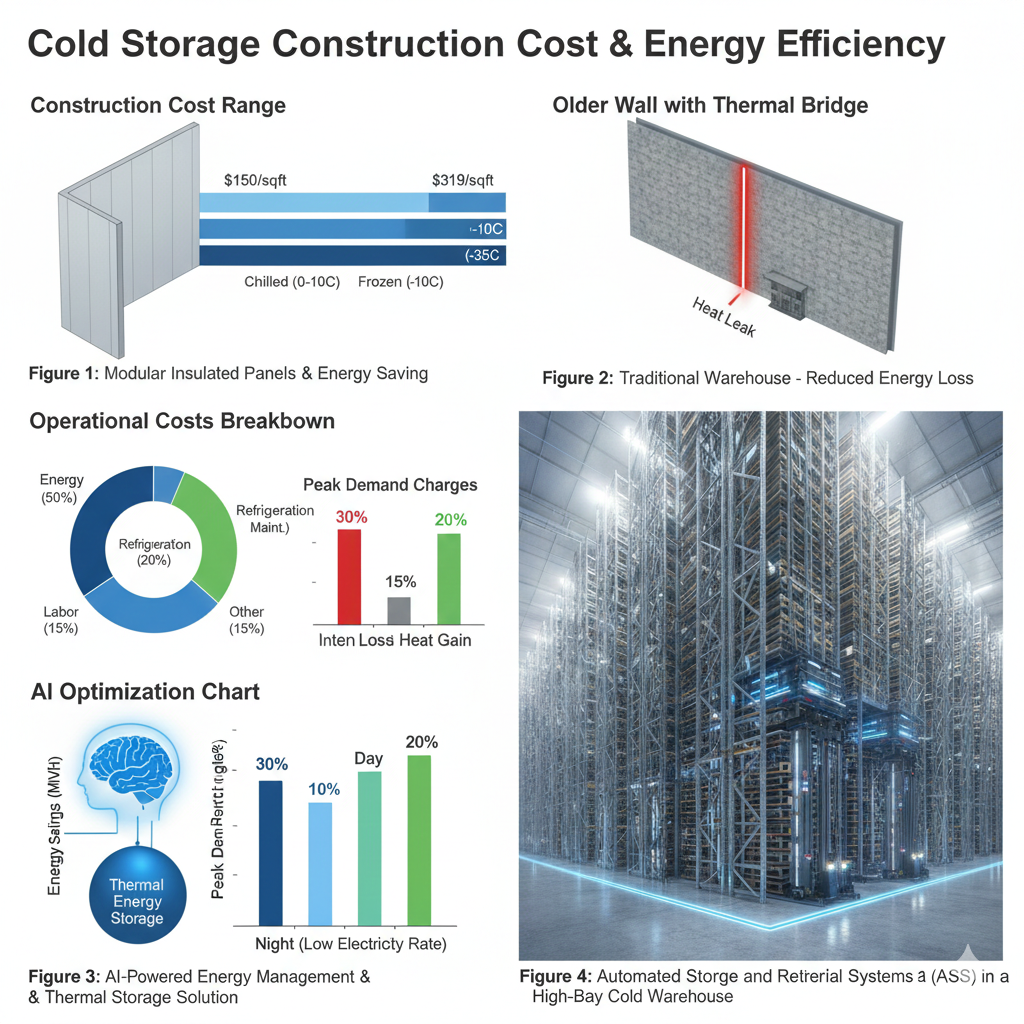
Here’s an illustrative breakdown of how different cold storage types compare in terms of construction and operating costs.
The Real Cost: Energy Consumption in 2026
For a cold storage operator, the electricity bill is the largest recurring expense, often accounting for 60% to 70% of total operational costs.
A typical 100,000-square-foot facility can easily exceed $500,000 in annual energy expenses. This is why “low-bid” refrigeration systems often become the most expensive option over a 10-year period. Investing in energy efficiency is not just about being “green”—it’s about protecting your margins.
You can see a typical breakdown of operational costs, highlighting the dominance of energy expenses.
Top Strategies for Cold Storage Energy Efficiency
To remain competitive, modern facilities are adopting these four key efficiency drivers:
The first line of defense is the building envelope.
·PIR Panels: High-performance Polyisocyanurate (PIR) panels provide superior R-values compared to older materials.
·Thermal Bridge Elimination: Ensuring there are no gaps in the insulation where heat can leak in (thermal bridges) can reduce cooling demand by up to 15%. This diagram illustrates how heat leaks can significantly compromise efficiency in older designs
Moving away from traditional HFCs to natural refrigerants like CO2 (R744) or Ammonia (R717) is becoming the industry standard. These systems offer higher Energy Efficiency Ratios (EER) and future-proof your facility against refrigerant phase-out regulations.
One of the biggest breakthroughs in 2026 is the use of AI to manage “peak demand.” By using Thermal Energy Storage, facilities can “over-cool” during the night when electricity rates are low and “coast” during the day when rates are high, reducing peak electricity costs by up to 30-50%. This chart demonstrates how AI can optimize energy usage throughout the day.
Automation does more than save labor. Automated warehouses allow for higher storage density and fewer door openings, which minimizes the “heat gain” that occurs when human-operated forklifts enter and exit the cold zone. Here’s an example of an advanced ASRS in action, showing how efficient storage can look.
Conclusion: Balancing Upfront Cost with Long-Term ROI
When choosing a cold storage supplier, the lowest price today often leads to the highest cost tomorrow. A facility designed with high-efficiency insulation, natural refrigerants, and smart energy management can pay for its “premium” features within just 3 to 5 years through energy savings alone.
Looking for a customized cold storage solution?
Our team specializes in designing energy-efficient cold rooms tailored to your specific industry needs. Contact us today for a consultation!